
I Joists
Wood I-joists are very efficient at utilizing wood fiber. The flanges (the top and bottom of the assembled member) are designed to resist bending forces and provide stiffness to the product. The web section, typically plywood or oriented strand board (OSB) is designed to resist the shear forces in the joist. The connection between the two typically occurs in a groove in the flange where adhesive has been applied. The efficiencies obtained through the use of an “I ” cross section require additional considerations relative to solid rectangular sections. Design values are derived according to the principles of ASTM D5055, Standard Specification for Establishing and Monitoring Structural Capacities of Prefabricated Wood I-Joists.
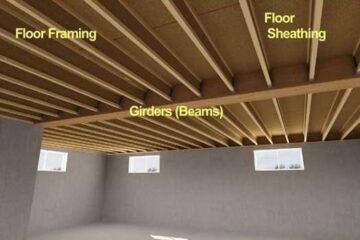
Floor I-joists are supported at exterior walls and by girders. The I-joists can bear directly on top of the girder or be supported in joists hangers.
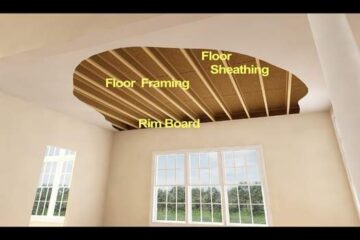
Ceiling cut-away reveals second floor framing bearing on exterior walls. The direction which the framing spans is not easily determined once the gypsum wallboard is installed and finished.
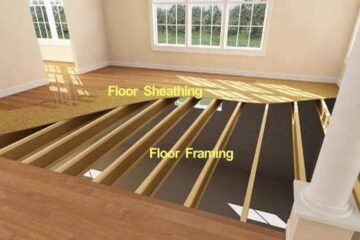
First floor framing is sheathed with wood structural panels and hardwood flooring. There may be no ceiling installed in a basement.
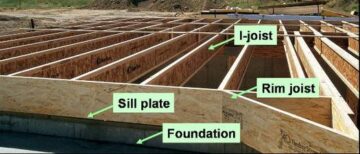
I-joists and the rimboard commonly bear directly on a sill plate that is fastened to the foundation.
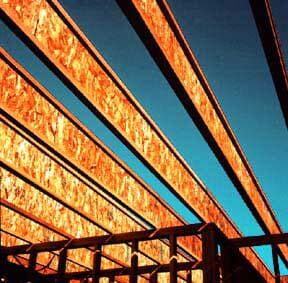
I-joists generally don't have longer span capabilities than equivalent depth lumber joists. They are available in long lengths, which allows a single I-joist to span the entire width of a house, but with an intermediate support.
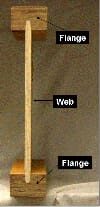
An I-joist is comprised of flange and web material. Manufacturers use different combinations of products, based upon many different factors.

The web is joined to a groove in the flange with strict tolerance. Adhesive is used to secure the joint.
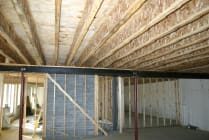
I-joist floor assemblies can be constructed to bear on a steel girder and column system as shown in this single-family dwelling basement.
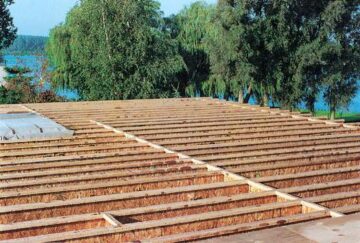
I-joist floor framing just before the floor sheathing is placed.
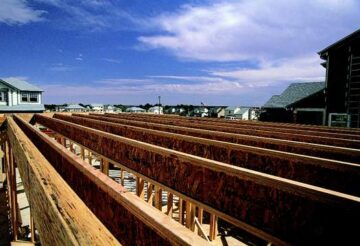
I-joist floor framing system under construction.
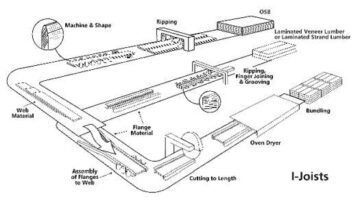
This illustration shows the typical manufacturing process for I-joists.
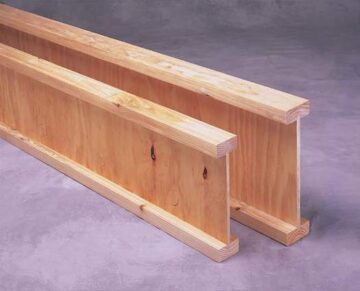
Early I-joists were constructed with solid sawn flanges and plywood webs. OSB has replaced plywood in the web, but lumber flanges are still common.
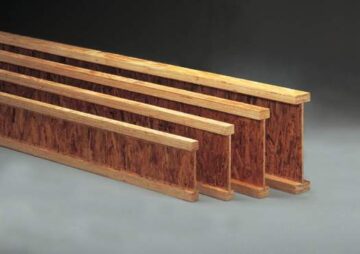
I-joists are available in a variety of depths and web/flange configurations. Most I-joists used in residential construction are slightly deeper than equivalent solid lumber products.
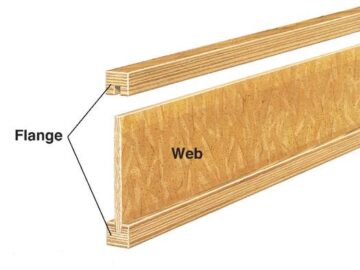
The web material is matched to the flange to create a resource-efficient building product.
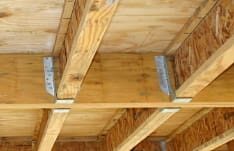
Plywood floor sheathing is used in combination with I-joists and a LVL girder.
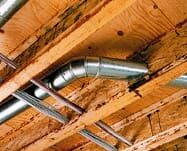
Plywood floor sheathing is used in combination with I-joists. A section of the web has been removed to allow for the passage of ductwork and electrical wiring.
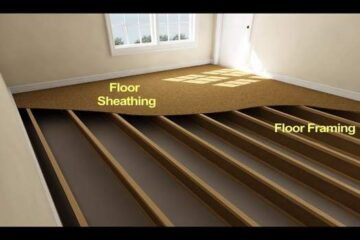
Elements of a floor framing system.
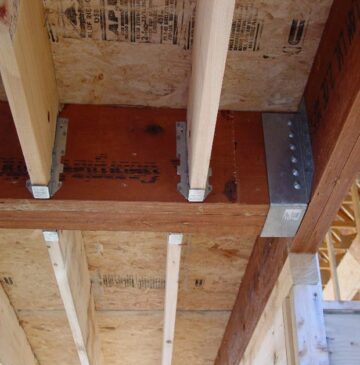
Beams and Joists Intersecting.
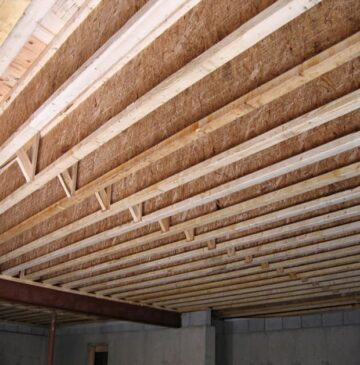
IBS bridging is a manufactured wood bridging product that can be used with I-joists to increase stiffness and reduce bounce and vibration.