Sustainability Standards, Technical Work Helps Protect Long-Term Market Access
AWC’s work on sustainability standards has become increasingly critical as international expectations evolve and market access depends more heavily on credible, science-based environmental reporting. With global efforts to define how materials are evaluated for carbon and sustainability performance, AWC has positioned the wood products industry as a leader in protecting long-term market access and ensuring wood is accurately represented in standards used throughout policy, codes and green building programs.
A major milestone this year was the completion of the four-year effort to develop the ISO 13391 series, a suite of three standards focused on value chain emissions, harvested wood products, forest carbon balance, and displacement effects. This standard offers a globally recognized alternative to the Greenhouse Gas Protocol for organizational reporting, making involvement essential for the wood products sector. AWC initiated and led the Technical Advisory Group that enabled direct participation in the development process, and is now working closely with members to understand potential pathways for implementing the standard.
Following completion of the ISO 13391 series, AWC convened a meeting that included member companies and external stakeholders to discuss how it can be used in organizational reporting, including from organizations in the European Union that are beginning to use the standard. The conversation provided valuable insight into how ISO 13391 may shape the broader and increasingly complex sustainability reporting landscape for U.S. manufacturers.
AWC Markets and Sustainability also engaged on a number of ancillary standards that impact member companies, including topics such as blockchain for European Union Deforestation Regulation tracking/transparency and various proposals that emerge from standard developers that may have future impacts on the wood sector.
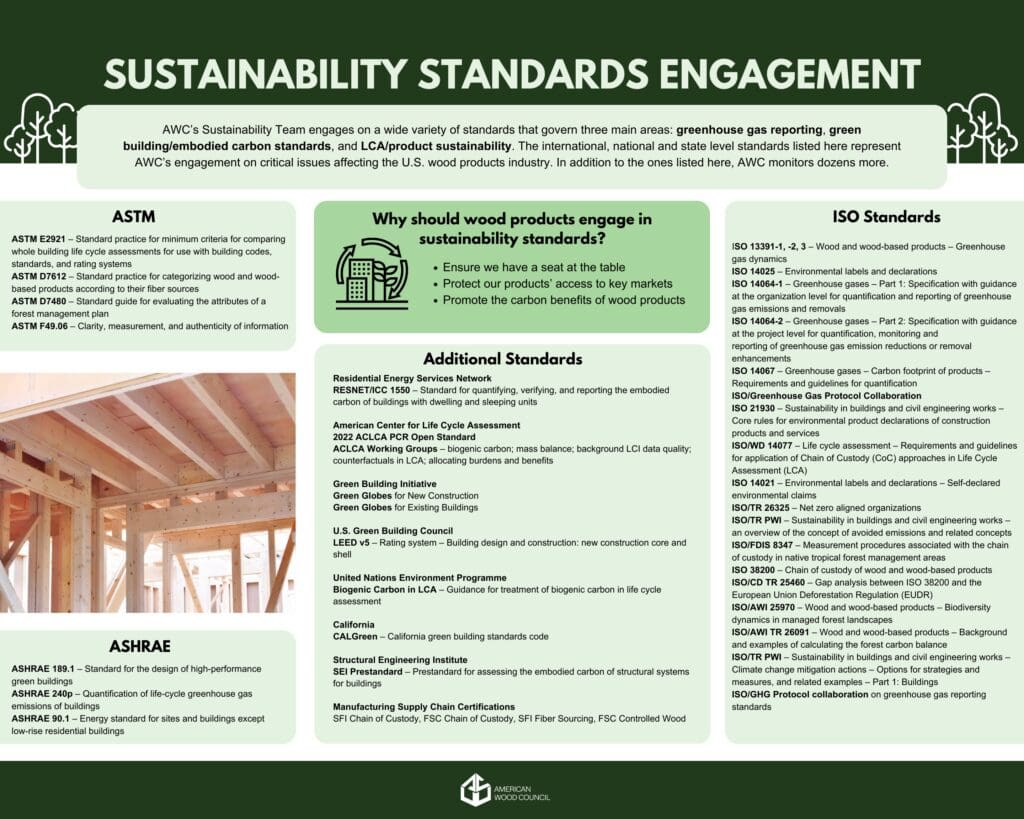
Collectively, these efforts, and many others not specifically mentioned but happening among the standards listed in the infographic, help maintain a fair, credible, and scientifically grounded standards landscape. That landscape, in turn, protects long-term market access and supports the growing recognition of wood’s sustainability benefits.