
Shaping Seismic and Wind Design Criteria
Updates to the National Earthquake Hazard Reduction Program (NEHRP) Provisions are winding down, marking an important milestone for seismic design criteria that ultimately influence the code-referenced ASCE 7 and the nation’s building codes. AWC played a leading role throughout the update cycle, particularly in developing the seismic response factor, Rs, for CLT diaphragms designed using AWC’s Special Design Provisions for Wind and Seismic (SDPWS) standard.
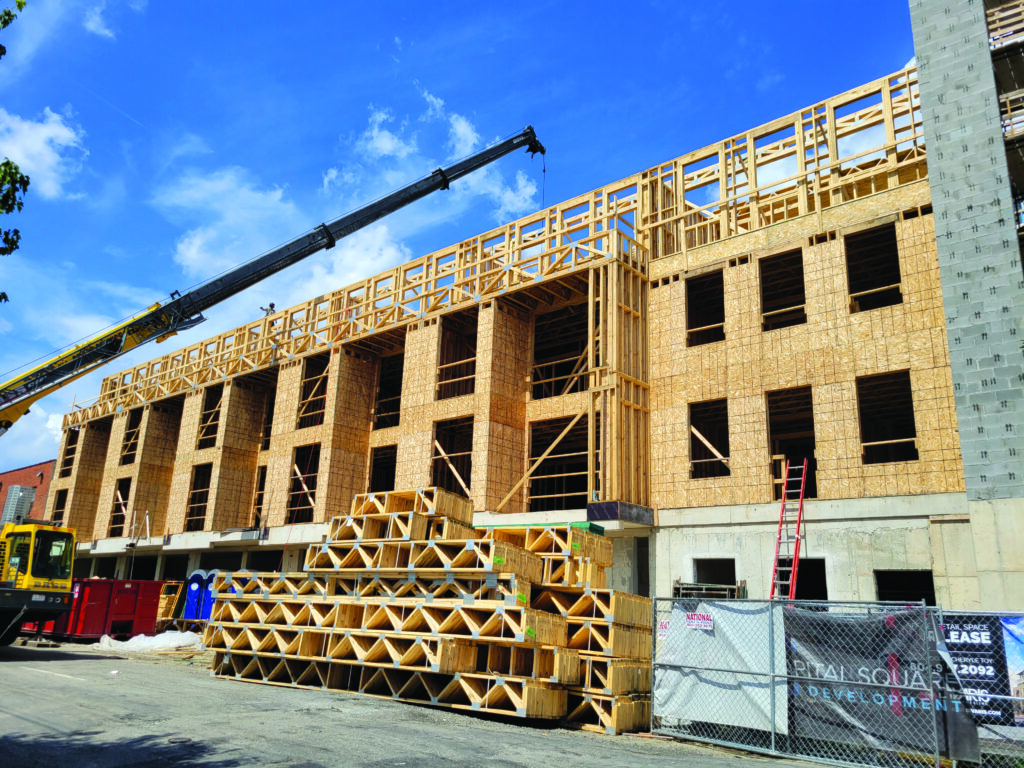
Another major outcome of this cycle was the NEHRP update committee’s renewed support for the use of two-stage analysis method for podium structures. This support is crucial given the initial negative review of its use for designing wood-frame buildings on concrete podiums. The change in position was based on thousands of building simulations conducted by AWC staff to demonstrate that wood-frame buildings on concrete podiums will perform well. The 2026 NEHRP provisions provide the basis for many changes proposed to the seismic provisions in the ASCE 7 load standard, making AWC’s involvement and ability to demonstrate the research behind the two-stage analysis especially impactful. This ultimately helps protect continued use of the multi-story wood structure above a concrete podium in seismic zones.
As the NEHRP provisions were under development, ASCE 7 began balloting its complete revamp of its wind design provisions. The revised approach will combine the main wind force resisting system (MWFRS) provisions from Chapter 27 (buildings of all heights) and Chapter 28 (low-rise buildings) into a single set of MWFRS provisions. The result is expected to increase wind design loads for low-rise buildings. AWC actively participated in these technical debates and successfully redirected the design requirements for torsional wind loading to a simpler and less restrictive methodology for buildings with flexible diaphragms, such as those with wood structural panel sheathed roof and floor assemblies. While this represents a big improvement, significant changes to low rise wind design are still anticipated when the new MWFRS requirements are adopted into the building codes.
In preparation for the impact of these changes, AWC is analyzing the design load increases in the development of new wind design provisions in AWC’s 2030 Wood Frame Construction Manual for One and Two-Family Dwellings (WFCM) standard. Because the WFCM is referenced in both the International Building Code (IBC) and the International Residential Code (IRC), the calculations and design requirements are the basis for prescriptive wind design provisions in the IBC and IRC in relatively low-wind regions. Thus, this work will be critical in helping designers apply the upcoming code changes efficiently and accurately.