
Comprehensive Advocacy on Housing Results in Key Win and Increased Demand
With clear member direction, AWC strategically engaged on housing policy initiatives and legislation throughout 2025. With the affordability of homes being a bipartisan concern, AWC has strategically positioned wood products as a partner in addressing our nation’s housing crisis and advocated for the role our mills and manufacturers play in rural communities. In a highly divided and unpredictable Congress, AWC targeted where and when we engaged, resulting in a consequential legislative win for the industry: the permanent extension and expansion of the Low-Income Housing Tax Credit (LIHTC).
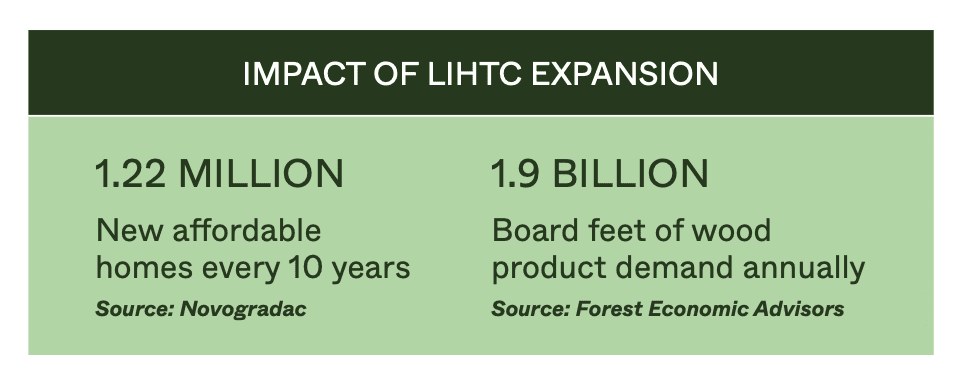
Congress passed, and the President signed into law the “One Big Beautiful Bill,” which permanently authorized LIHTC and included a 3% increase to the original credit. Previously subject to continuous short-term extensions, LIHTC now offers long term certainty for housing markets and the manufacturing supply chain. The impact on our industry and communities include:
AWC’s leadership on housing also opened discussions with federal decision makers and national partners, including:
- A field meeting with U.S. Forest Service Chief Tom Schultz
on the ground in Georgia, highlighting mill operations and
rural economic impacts. - An invitation-only roundtable discussion with Senator Mike Crapo and Housing and Urban Development Secretary Scott Turner on affordable housing.
- A featured speaking role for AWC President & CEO Jackson Morrill at the American Institute of Architects’ Housing Summit on the Neighborhood Homes Investment Act (NHIA), where he spoke on how to capitalize on the current bipartisan support for solving the ongoing housing crisis.
Building on these successes and targeting existing, viable legislative opportunities, AWC has joined the NHIA coalition in early 2025 to lend manufacturing and materials expertise to outreach efforts. The Act offers a tax credit to incentivize new home construction and rehabilitation projects, which is estimated to spur the construction or rehabilitation of 500,000 homes. AWC retained Forest Economic Advisors to develop a white paper that concluded that NHIA would support an annual demand of 500 million board feet of lumber and additional millions of square feet of plywood and oriented strand board.
The white paper, entitled “Unlocking Affordable Housing through NHIA – The Neighborhood Homes Investment Act,” has served as a valuable tool for educating lawmakers on how NHIA supports manufacturing economies and identifies often forgotten supply-side issues.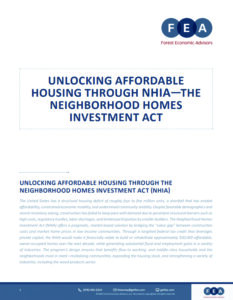
The FEA paper was used during National Forest Products Week, where, even amid a government shutdown, AWC secured staff-level meetings on Capitol Hill to discuss how the U.S. wood products industry is a key partner in addressing housing affordability. AWC’s engagement and success in reaching members of Congress and getting a Letter-to-the-Editor placed early in the year led the coalition to invite AWC to become a core member, showing our leadership and the recognition of the valuable role our industry plays in housing.
With the 2026 federal legislative session underway, AWC remains focused on advancing policies to increase the housing supply and promote the use of wood products, such as NHIA.