
Studs
Studs are a series of vertical load-bearing members used to support elements in walls and partitions. Studs in exterior walls of one- and two-story buildings are at least a nominal 2×4 inches with the 4-inch dimension forming the basic wall thickness. Stud spacing is normally 16 inches in exterior walls, although 24-inch spacing of 2×4 studs is acceptable in one-story buildings if wall sheathing or siding is of adequate thickness to bridge across studs. In three-story buildings, studs in the bottom story are at least nominal 3×4 or 2×6 inches and may not exceed 16-inch spacing. Studs are arranged in multiples at corners and partition intersections to provide for rigid attachment of sheathing, siding, and interior wall finish materials. Nailing strips or metal clips may be used to back up interior finish at corners.
Solid Sawn Studs
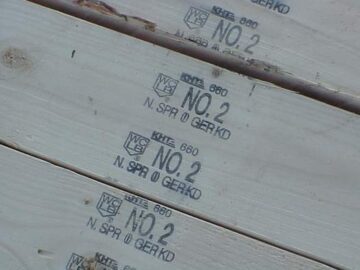
A grademark identifies the species, grade, grading agency, and mill number. This information allows the product to be traced to the mill of origin, as well as establishing the structural properties of the piece of lumber.
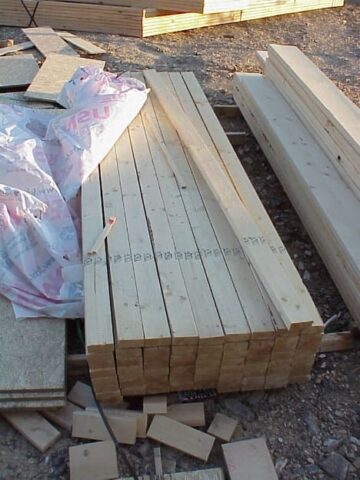
Most 2x4 dimension lumber is visually graded and marked with an ink stamp at the mill. The markings on this bunk of lumber provide information to ensure the product has the strength for the application.
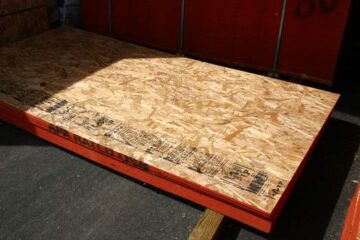
The exterior wall is framed with OSB sheathing and lumber studs. 2x4 blocking is installed as firestopping where the exterior wall and the cathedral ceiling intersect. The cathedral ceiling is created using pitched chord trusses.
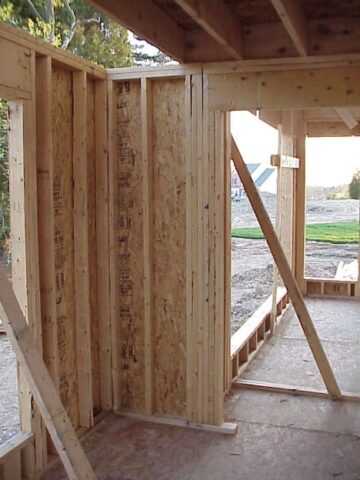
Headers require multiple studs for end bearings to support floor and roof loads from stories above. Most builders use two top plates in wall construction.
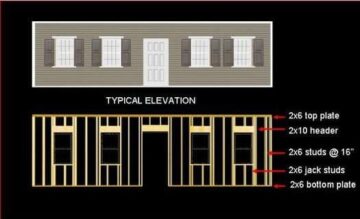
Once the exterior wall sheathing is attached, the exterior wall framing is no longer visible. This typical framing drawing details how headers and walls studs are used to construct an exterior wall.
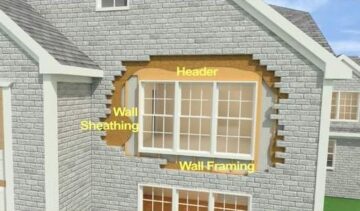
This exterior wall cutaway reveals the wall framing.
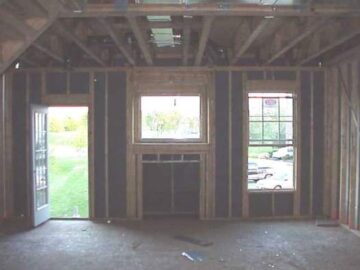
Exterior wall framing supporting parallel chord trusses.
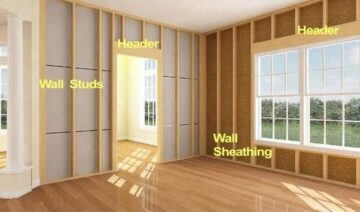
Typical wall framing is revealed beneath the gypsum wallboard sheathing.
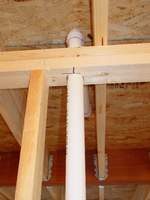
Walls are typically framed with double top plates. Piping and wiring penetrate the double top plate.
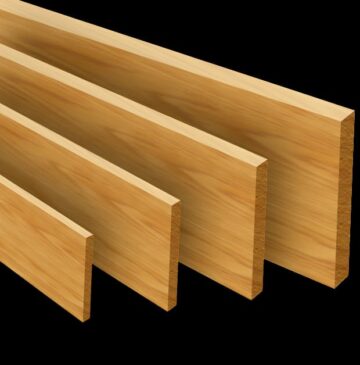
Lumber is commonly available in nominal 2" thickness and widths of 4" to 12".
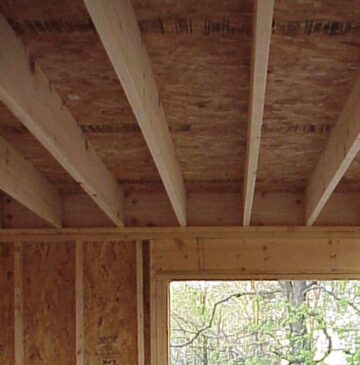
OSB floor and wall sheathing is combined with lumber floor joists, wall studs, and headers in this traditional whole-house framing package.
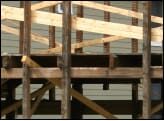
Wall studs in balloon framing are continuous for the total height of the wall. Floor joists are supported in a ledger that is attached to the studs. Balloon framing must be firestopped in accordance with the building code.
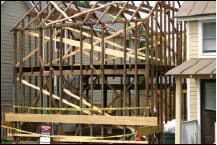
Continuous exterior wall studs in balloon framing. Firestopping is necessary to isolate the vertical and horizontal cavities and to limit the height of the wall cavity.
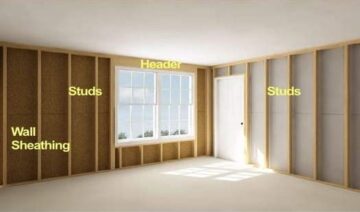
Elements of a stud wall.
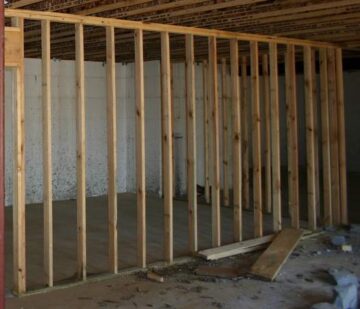
Studs.